What Leaseholders Actually Want From a Resident Portal — And How Block Management Software Delivers It
Property Management • 11 May
There is a conversation that happens in block management offices across the UK every day, dozens of times, that should not need to happen at all. A leaseholder calls or emails to ask about the status of a maintenance issue they reported three weeks ago. Another wants to know what the current service charge balance is. A third is asking for a copy of a document they were sent eighteen months ago and cannot find. An RTM director wants to understand the financial position of the reserve fund before the next board meeting.
Each of these conversations takes time — time from the leaseholder, who has had to pick up the phone or compose an email to find out something they should already be able to see, and time from the property manager, who has to stop what they are doing to find an answer to a question that the right software should be answering automatically.
This is the problem that leaseholder portal software UK managing agents are increasingly turning to. Not as a nice-to-have feature, but as a structural solution to one of the most persistent sources of inefficiency in block management — the gap between the information leaseholders need and the information they can access without calling the office.
What a Leaseholder Portal Actually Is
A leaseholder portal is a dedicated, secure online interface through which residents and RTM directors can access information about their building, report issues, track the progress of those issues, review their service charge accounts, access documents, and communicate directly with their management team — without needing to send an email or make a phone call to obtain any of it.
The best block management leaseholder portal is not a static information page or a document dump. It is a live, interactive interface that reflects the current state of the building's management — the actual status of reported issues, the actual current service charge balance, the actual documents on file — rather than a snapshot that was accurate when it was uploaded but may already be out of date.
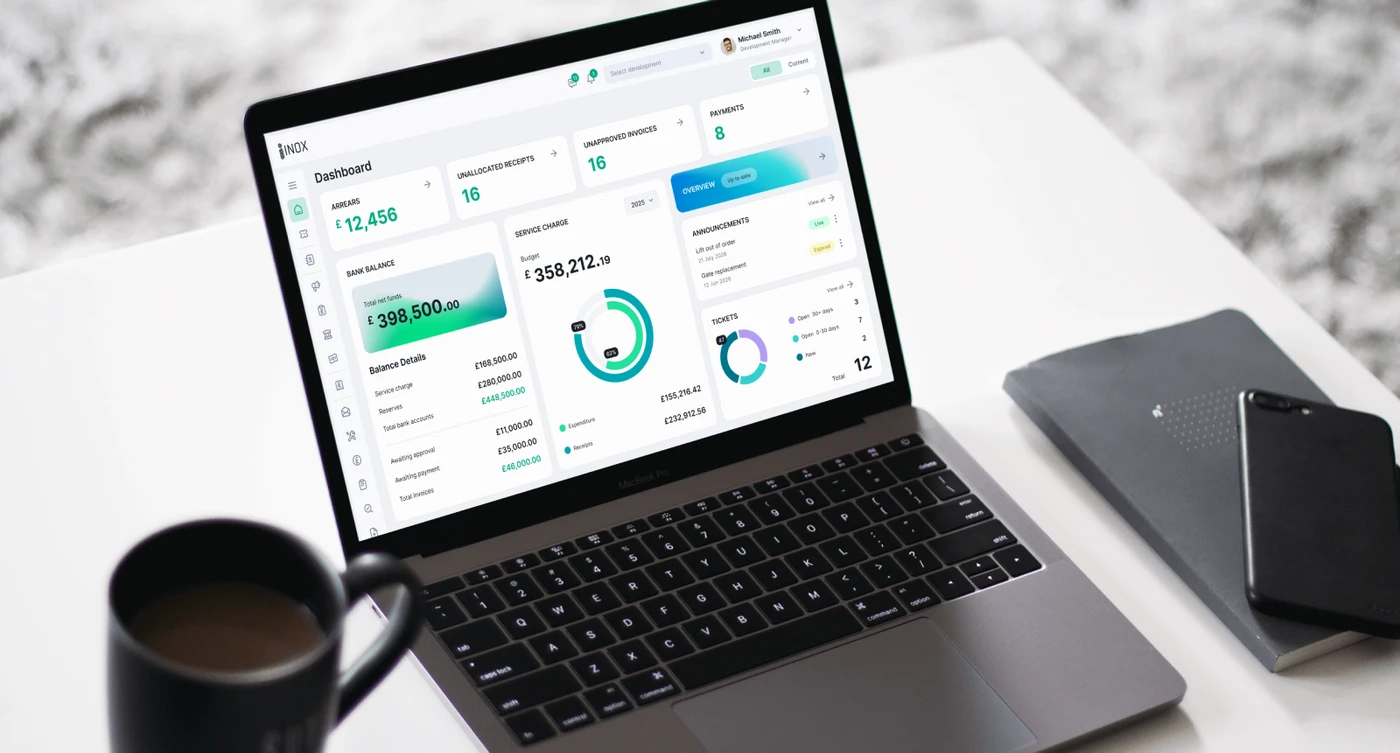
At Inox, the leaseholder portal is built into the core of the platform rather than added as a peripheral feature. Everything that happens in the platform — every ticket created, every invoice processed, every payment made, every document uploaded — is reflected in what leaseholders and RTM directors can see through their portal, in real time.
What Leaseholders Actually Want
The starting point for understanding what a good resident portal block management software should include is understanding what leaseholders actually want from it — which is simpler than most software vendors acknowledge.
Leaseholders want to know that the issue they reported has been received, is being dealt with, and will be resolved. They want to be able to check their service charge account without having to request a statement. They want access to the documents that relate to their building — the insurance schedule, the budget, the health and safety certificates — without having to email the office and wait for a response. And they want to be able to communicate with their management team directly, in the context of a specific issue, without that communication disappearing into a shared inbox where it may or may not be picked up by the right person.
None of these wants are unreasonable. All of them are achievable with the right leaseholder communication software. And all of them, when met, significantly reduce the inbound communication volume that consumes so much property manager time.
How a Leaseholder Portal Reduces Admin for Managing Agents
The efficiency case for leaseholder self-service portal software is straightforward and consistent. When leaseholders can access the information they need without contacting the office, the volume of routine inbound queries falls. When that volume falls, property managers have more time for the work that actually requires their expertise. The portal does not replace the property manager — it removes the routine so that the property manager can focus on the complex.
At Inox, managing agents using the platform consistently report meaningful reductions in email volume and inbound query handling time after implementing the leaseholder portal. The reduction is most pronounced for the three most common categories of inbound query: status updates on reported issues, requests for financial information, and requests for documents. All three are addressed directly by the portal — issues are tracked and updated automatically, service charge account information is accessible in real time, and documents are stored and accessible on demand.
For RTM directors and members of resident management companies, the portal delivers an additional layer of governance value. RTM director portal software that provides real-time financial reporting, document access, and direct communication with the management team gives directors the information they need to fulfil their legal and fiduciary responsibilities without depending on the managing agent to produce a bespoke report every time a question arises.
Mobile Access and the Leaseholder Experience
A leaseholder portal that can only be accessed from a desktop computer is a portal that most leaseholders will use rarely, if at all. The mobile leaseholder portal app is not a secondary consideration — it is the primary one, because most residents will engage with the portal from their phone when an issue occurs or a question arises, not from a computer when they happen to be at a desk.
At Inox, the leaseholder portal is fully accessible on both mobile and desktop, with the same functionality and the same simplicity across both. A leaseholder reporting a maintenance issue at eleven o'clock at night can submit that report from their phone in under a minute, see it immediately converted to a tracked ticket, and receive confirmation that it has been received — without waiting until office hours to make a call or send an email.
Leasehold Reform and the Case for Acting Now
The regulatory direction of travel in residential leasehold management is unambiguous. Transparency, accountability, and leaseholder access to information about their building are moving from best practice to expectation — and in some areas, to requirement. Property management software leasehold reform ready is not a future consideration for managing agents building their technology stack. It is a present-tense requirement for firms that want to be ahead of the curve rather than scrambling to catch up.
Leaseholder transparency software that gives residents real-time access to their service charge accounts, their reported issues, and their building documents is not just operationally valuable. It is the right thing to do — and increasingly, it is what the regulatory landscape demands.
At Inox, the leaseholder portal is not a compliance checkbox. It is a genuine commitment to giving every stakeholder in the building the access, the transparency, and the communication tools they deserve.
See the Inox leaseholder portal in action. Book a demo at www.inoxliving.io/get-demo