How Open Banking Is Transforming Financial Management for UK Block Management Companies
Property Management • 18 May
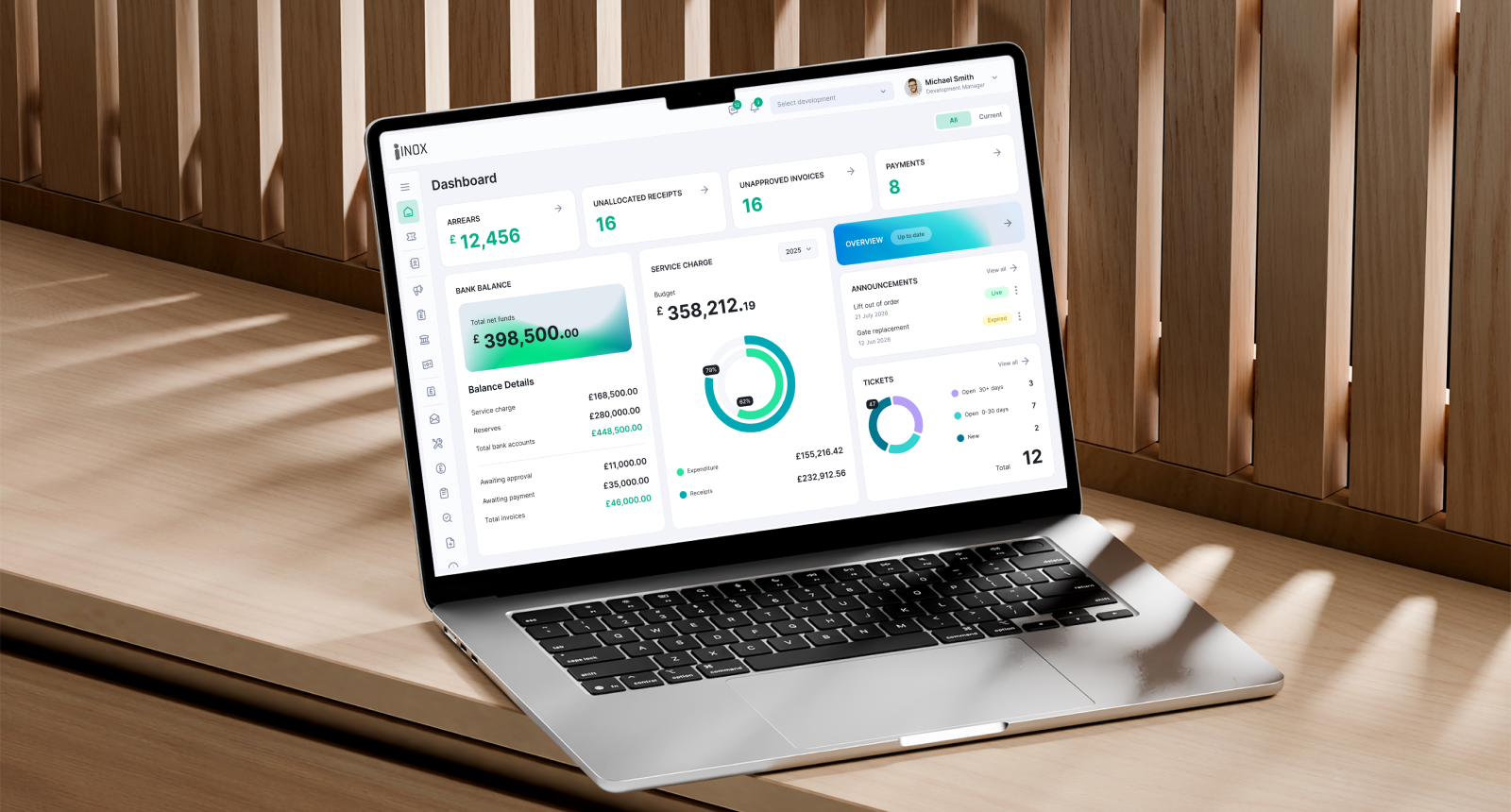
Ask any accountant working in block management what the most frustrating part of their job is, and the answer follows a familiar pattern. Not the complexity of leasehold finance — that is expected, and they are trained for it. Not the volume of invoices — that is manageable with the right tools. The frustration is almost always the gap between the financial data that exists and the financial data that is accessible in real time. Bank statements that are a day behind. Reconciliations that happen once a month rather than continuously. Service charge accounts that reflect last week's position rather than this moment's. Bookkeeping that requires someone to manually bridge the gap between what the bank knows and what the accounting system knows.
That gap is closing. And open banking is closing it.
At Inox, we have built open banking integration into the core of our block management software because we understand that real-time financial data is not a luxury feature for managing agents — it is the foundation of accurate, efficient, and defensible leasehold financial management. Here is what that means in practice.
What Open Banking Actually Does for Managing Agents
Open banking is a regulatory framework that allows software platforms to connect directly and securely to bank accounts, with the account holder's permission, and receive transaction data in real time. For managing agents, this means that the gap between a payment being made or received and that payment being reflected in the service charge accounts can be reduced from days to seconds.
In a traditional block management accounting workflow without bank feed integration, the reconciliation process is manual and periodic. A member of the accounting team downloads a bank statement, cross-references each transaction against the accounting records, identifies discrepancies, investigates them, and updates the records accordingly. This process happens at month end, it takes significant time, and in the period between reconciliations the accounting records and the bank account are out of sync. Decisions made during that period — on expenditure, on arrears, on budget positions — are made on the basis of data that may be days or weeks out of date.
Open banking property management software eliminates this problem. When Inox connects to a block's bank account via open banking integration, transactions flow into the platform automatically and continuously. Real-time bank reconciliation updates service charge accounts as payments are made and received, without any manual intervention from the accounting team. The month-end reconciliation exercise becomes a confirmation rather than a discovery — a quick check that everything has been captured correctly rather than a multi-hour exercise in matching and correcting.
Real-Time Financial Data Across the Whole Portfolio
The impact of open banking extends well beyond the reconciliation exercise. When real-time financial data flows continuously into the platform from every block in the portfolio, the financial picture available to property managers, senior leadership, and clients changes fundamentally.
Arrears are visible the moment they arise rather than at the next statement date. Budget positions are current rather than based on last month's figures. Service charge balances reflect actual transactions rather than projected ones. A property manager approving expenditure on maintenance work can check the actual available budget in real time before committing the spend, rather than working from a figure that was accurate three weeks ago.
At Inox, this real-time financial visibility is built into every layer of the platform. Property managers, accountants, and directors all see the same live financial data, drawn from the same open banking connection, in the same platform. There is no version control problem, no stale report, and no risk of two people in the same organisation working from different numbers.
Automated Bookkeeping: From Hours to Minutes
The combination of open banking integration and AI-powered invoice processing creates the conditions for genuinely automated bookkeeping in block management — something that was not practically achievable with the manual and semi-manual tools that most managing agents have relied on until recently.
At Inox, automated service charge bookkeeping works as follows. Invoices are uploaded in bulk and processed by AI, which reads, categorises, and prepares each invoice for approval automatically. Payments are made directly from the platform. Open banking feeds transaction data back into the service charge accounts in real time. The result is a bookkeeping process that runs continuously, automatically, and with minimal manual intervention — freeing the accounting team from the routine data entry and reconciliation tasks that have historically consumed the majority of their time.
For managing agents asking whether block management software can replace a bookkeeper, the honest answer is that it cannot replace the judgement, expertise, and client relationships that a skilled property accountant provides. But it can replace most of the manual, repetitive, data-entry-intensive work that a significant proportion of a bookkeeper's time currently goes on — allowing them to focus on analysis, advice, and the higher-value financial work that their clients actually pay for.
Financial Statements That Are Always Ready
One of the downstream benefits of real-time financial data and automated bookkeeping is the transformation of financial reporting. When service charge accounts are continuously reconciled and always current, producing financial statements is no longer an exercise in preparation — it is an exercise in presentation.
At Inox, service charge financial statements can be produced at any point in the financial year, reflecting the actual current position of the block's accounts rather than a point-in-time snapshot that was accurate when it was compiled but may already be out of date by the time it reaches the client. Year-end accounts, management accounts, and client financial reports are all generated from the same real-time data, ensuring consistency and eliminating the discrepancies that arise when different reports are produced from different sources at different times.
For leaseholders and RTM directors who want financial transparency — and the evolving regulatory landscape around residential leasehold management increasingly means they will demand it — the ability to access accurate, up-to-date financial statements through the leaseholder portal at any time is a significant step forward from the annual or biannual statements that most currently receive.
The Financial Management Your Business Deserves
Open banking, real-time financial data, automated bookkeeping, and accurate service charge financial statements are not separate features. They are components of a single, integrated financial management system that works continuously rather than periodically, automatically rather than manually, and accurately rather than approximately.
For block management companies still relying on manual bank reconciliation, periodic bookkeeping, and retrospective financial reporting, the gap between how financial management currently works and how it could work is significant. The technology to close that gap exists today. At Inox, it is already deployed and working for managing agents across the UK.
See how Inox's open banking integration transforms block management accounting. Book a demo at www.inoxliving.io/get-demo